Your workshop is ready.
Except for those first five minutes.
You don't want to start with another round of introductions.
You don't want to ask everyone for a fun fact.
And you definitely don't want to grab a random icebreaker off the internet just because you need something to get started.
So you keep coming back to the same question:
How do I open this?
This Is Not an Icebreaker helps you answer a different question.
Not by giving you even more fun activities.
But by helping you decide what this particular group needs from its first few minutes together.
Maybe this feels familiar.
Your workshop is ready, but you're still unsure about the first five minutes.
You google good icebreakers for groups and find dozens of activities that somehow don't quite fit.
You have an exercise that worked last time and wonder if you can just use it again.
You want people to connect, but don't want to force anyone to share something personal.
Or you skip the whole thing and go straight to the agenda.
The problem probably isn't that you don't know enough activities.
It's that we tend to start with the wrong question:
Which icebreaker should I use?
When the more useful question is:
What do these people need in order to enter this conversation?
An opening doesn't have to break the ice.
Sometimes people need to arrive first.
Sometimes they need to connect.
Sometimes you want to spark curiosity.
Sometimes safety and choice need to come first.
Sometimes you want people to experience agency from the very beginning.
And sometimes you want to reconnect them with why you're all here in the first place.
Those are six different intentions:
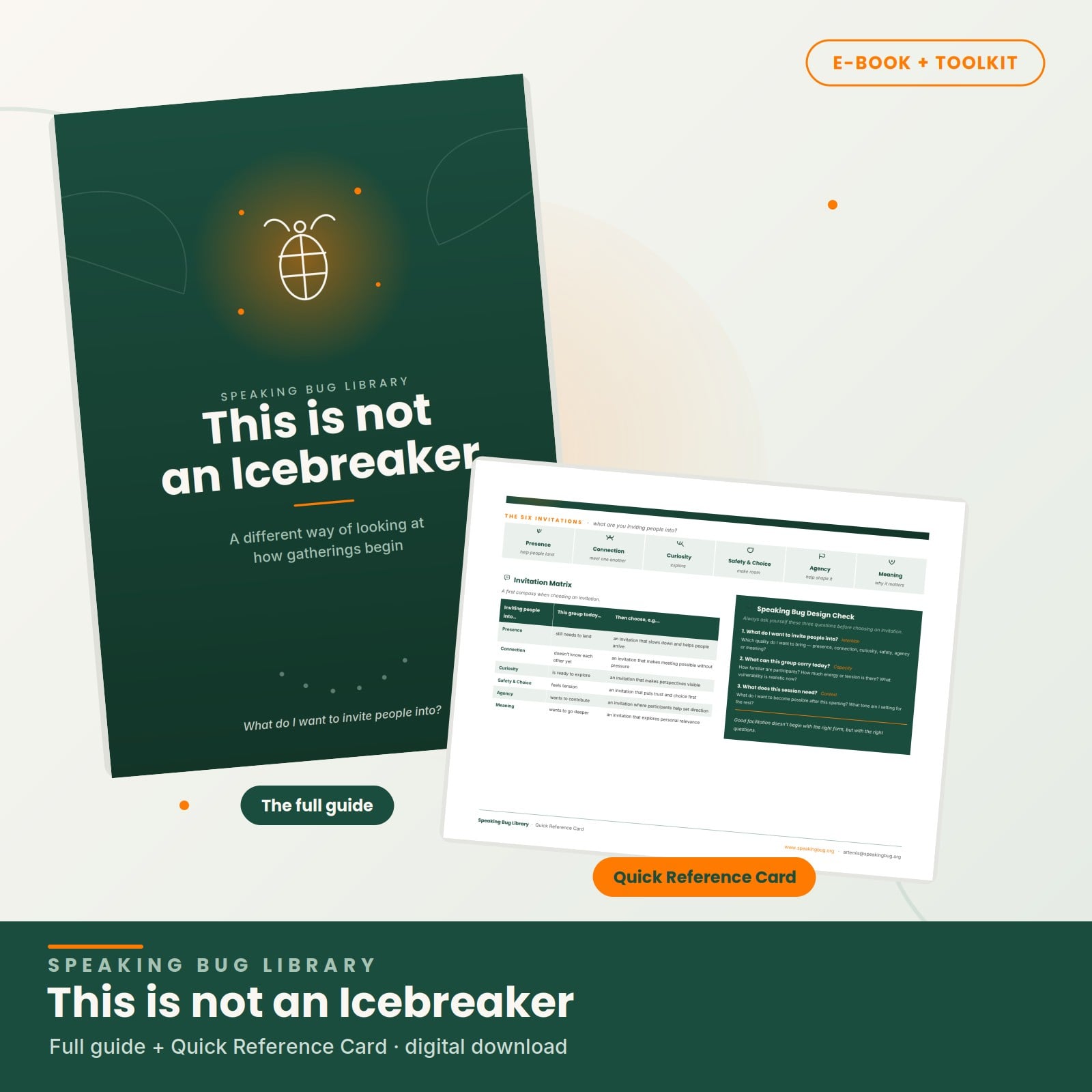
Presence. Connection. Curiosity. Safety & Choice. Agency. Meaning.
And they don't necessarily need the same opening.
That's the thinking behind The Invitation Model.
Instead of asking:
"What activity should I do?"
you start with:
"What am I inviting people into?"
Then you design or choose an opening that actually fits.
That's why I made This Is Not an Icebreaker.
It's not a collection of tricks to get people talking.
It's a practical toolkit for making more intentional choices about how you bring a group into a conversation.
Inside you'll find:
The Invitation Model
A simple framework built around six intentions, helping you decide what your opening actually needs to do.
15 ready-to-use Invitations
Openings you can use as they are or adapt to your group, purpose and context.
The thinking behind each Invitation
Not just instructions, but what each one is designed to invite - so you can decide whether it actually fits.
Reflection questions and practical considerations
To help you think about safety, choice, participation and context.
AI prompts
To adapt existing Invitations or design your own without losing sight of the intention behind them.
A Quick Reference Card
For when you don't want to reread the whole toolkit while preparing tomorrow morning's session.
You'll receive the digital toolkit immediately after purchase.
The goal isn't to make you use one of my 15 Invitations every time.
In fact, sometimes you might use none of them.
The goal is that next time you're preparing a workshop, meeting or conversation, you don't start with:
"Which fun icebreaker haven't I used yet?"
You start with:
What needs to become possible in these first few minutes?
And then you make a conscious choice.
An Invitation from the toolkit.
An adapted version.
Something entirely your own.
Or simply:
"Welcome. I'm glad you're here. This is why we're meeting today, and this is what I'll be asking of you."
Because that can be a good opening too.
For those moments when you think: how do I start this?
A workshop with people who don't know each other.
A team that knows each other almost too well.
A meeting where you need to get down to business quickly.
A difficult conversation.
A participatory process where you don't want the loudest voices to automatically take up all the space.
A group that first needs a moment to arrive.
Or simply:
You're standing in front of a group tomorrow at 9, and you still don't know what to do with those first five minutes.
That's what this toolkit is for.
What people are taking from it
"It inspired me to reflect further on how to understand the meaning and importance of the start of meetings and of check-ins."
- David, founder and facilitator
Who is it for?
For people who bring groups together and don't just want an activity to do, but want to think intentionally about what that activity makes possible.
You don't have to call yourself a facilitator.
Maybe you run workshops.
Lead meetings.
Moderate conversations.
Teach.
Manage a team.
Design participatory processes.
Or you simply find yourself regularly facing the question:
"Okay. Everyone's here. How do we begin?"
Then This Is Not an Icebreaker is for you.
Next time, you don't have to google "good icebreakers" again.
You'll have a framework for deciding what your group needs.
15 Invitations you can use right away.
And the tools to design your own when none of them quite fits.
This Is Not an Icebreaker - Speaking Bug Library, Volume 01 - €29
Digital toolkit · instant access after purchase
Still wondering?
No. The 15 Invitations are practical examples, but the core of the toolkit is The Invitation Model: a way to make more intentional choices about how you open a group conversation.
Yes. They're designed to be ready to use. You'll also get enough context to adapt them to your group, purpose and setting.
Then this toolkit may be particularly useful for you. A good opening doesn't have to be playful, personal or high-energy. Sometimes clearly welcoming people and setting the frame is exactly what's needed.
No. It's for anyone who brings groups together: trainers, moderators, managers, teachers, team coaches, community builders and people leading meetings or participatory processes.
No. It's a digital toolkit, so you'll get access immediately after purchase.
You don't have to break the ice.
You need to know what you're inviting people into.